Be among the first to get certified  |  Submit your catch →

RECORDS
SUBMIT
RULES
Official Guidelines

Rules & Regulations

Applies to all submissions to the Fish Certification Authority (FCA).

Section 01

Eligibility

Species Standards

Review the standards to ensure your catch qualifies for certification.

01

Species

Only species listed in the official FCA Species Standards table qualify.

02

Minimum Length

Each species must meet or exceed its published minimum length. Length is recorded in cm and inches.
03

Fish must be caught using legal rod-and-reel methods in compliance with local fisheries regulations.

Section 02

Measurement Standards

General Measurement Standard

Document: FCA-CS-001
Version: 1.0
Effective Date: September 1, 2026
Last Reviewed: August 2026
Status: Current

FCA applies the measurement method prescribed by the governing fisheries authority for the jurisdiction and species in which the fish was caught. Where no official measurement method is prescribed, FCA applies its standardized species-specific measurement convention, with Total Length serving as the default measurement method.

Depending on the species and jurisdiction, FCA may require:

  • Total Length (TL)
  • Fork Length (FL)
  • Lower Jaw–Fork Length (LJFL)
  • another recognized fisheries measurement where specifically prescribed

Anglers must use the measurement method specified by FCA for the particular species and jurisdiction. Measurements obtained using a different method may not be directly comparable and may not be accepted for certification.

Required Equipment

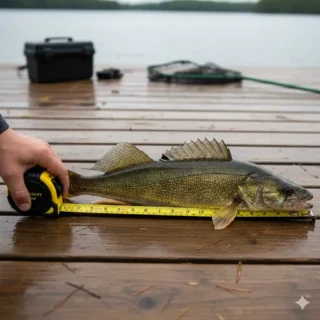
Fish should be measured using a rigid or semi-rigid measuring device that clearly displays the applicable units of measurement.

Acceptable devices may include:

  • rigid fish measuring boards;
  • bump boards;
  • commercially manufactured fish rulers; or
  • clearly marked measuring tapes positioned straight and flat beside the fish.

Whenever possible, FCA recommends using a measuring board with a fixed vertical stop at the zero mark. This helps position the fish consistently and reduces measurement error.

The measuring device must:

  • begin at a clearly visible zero point;
  • display readable measurement markings;
  • remain straight and flat during measurement;
  • be long enough to measure the entire required measurement; and
  • be visible in the verification photograph.

Do not estimate measurements or rely on markings that are damaged, stretched, obscured or difficult to read.

Rigid measuring board, ruler, or flat tape

Flat surface

Camera or smartphone

Preparing the Fish for Measurement

Place the fish on a flat, stable surface with the measuring device positioned directly beneath or immediately beside it.

The fish should be positioned naturally and must not be intentionally stretched, compressed or otherwise manipulated to increase its apparent length.

Before taking the measurement:

  • Make sure the measuring device is lying flat and straight.
  • Confirm that the zero mark is clearly visible.
  • Position the fish according to the required FCA measurement method.
  • Ensure that the applicable starting point and tail endpoint are aligned with the measurement scale.
  • Remove fishing line, lures, grips or other objects that could interfere with the measurement.

Whenever practical, the fish should be kept wet and handled carefully throughout the process.

Fish laid straight, not curved

Mouth naturally closed

Measured snout to longest tail point

Measurement taken in a straight line

Total Length Measurement

Total Length (TL) is FCA’s default measurement method when no other measurement convention has been prescribed for the species or jurisdiction.

Total Length is measured from:

the most forward point of the fish’s snout to the most distant point of the tail fin.

The fish should be positioned flat and straight along the measuring device.

Where permitted under the applicable measurement standard, the tail may be positioned sufficiently to determine the greatest legitimate overall length of the fish. The tail must not be stretched, pulled or manipulated beyond its natural range of movement.

The measurement is read at the farthest point of the caudal, or tail, fin.

Example

If the snout is positioned at zero and the farthest point of the tail reaches 76.4 centimetres, the recorded measurement is:

76.4 cm Total Length (TL)

Fork Length Measurement

Fork Length (FL) is used for species with a distinctly forked tail and may be required by particular fisheries authorities.

Fork Length is measured from:

the most forward point of the fish’s snout to the centre of the fork in the tail.

The endpoint is the inward point where the upper and lower lobes of the caudal fin meet.

The outer tips of the tail are not included in a Fork Length measurement.

The fish should be positioned straight and flat along the measuring device, with the snout correctly aligned at the zero point.

Example

If the snout begins at zero and the centre of the tail fork reaches 56.75 inches, the recorded measurement is:

56.75 inches Fork Length (FL)

Fork Length is commonly used for certain marine, pelagic and other fork-tailed species because the outer tips of the tail may be flexible and can produce greater variation in Total Length measurements.

If FCA specifies Fork Length for a particular species and jurisdiction, Total Length should not be substituted unless FCA rules specifically permit the alternative measurement.

Lower Jaw–Fork Length Measurement

Lower Jaw–Fork Length (LJFL) is a specialized measurement commonly used for certain billfish and other species where the extreme length of the upper jaw or bill would make conventional Total Length or Fork Length measurements less consistent.

Lower Jaw–Fork Length is measured from:

the most forward point of the lower jaw to the centre of the fork in the tail.

The fish should be positioned as straight as reasonably possible and the measuring device should follow a straight line parallel to the fish’s body.

The measurement begins at the tip of the lower jaw, not at the end of the upper jaw, bill or snout.

The measurement ends at the centre of the fork of the caudal fin, not at either outer tail tip.

Correct LJFL Procedure

  1. Place the fish on a flat and stable surface whenever practical.
  2. Position the measuring device straight alongside the fish.
  3. Locate the most forward point of the fish’s lower jaw.
  4. Align this point with the zero mark of the measuring device.
  5. Ensure that the fish’s body is positioned straight.
  6. Follow the measurement scale in a direct line along the length of the fish.
  7. Locate the centre of the fork in the tail.
  8. Read the measurement where the centre of the tail fork intersects the measuring scale.
  9. Record the measurement specifically as Lower Jaw–Fork Length (LJFL).

Example

If the tip of the lower jaw begins at zero and the centre of the tail fork reaches 82 inches, the measurement should be recorded as:

82 inches Lower Jaw–Fork Length (LJFL)

Important LJFL Requirements

When using LJFL:

  • do not begin the measurement at the tip of the bill or upper jaw;
  • do not measure to an outer tail tip;
  • do not follow the curvature of the body with a flexible tape;
  • do not stretch the fish;
  • do not angle the measuring device to increase the measurement; and
  • ensure both the lower-jaw starting point and tail-fork endpoint can be verified.

Because the difference between Total Length, Fork Length and Lower Jaw–Fork Length can be substantial, the measurement method must always be identified with the submitted length.

A submission should therefore state:

82 inches LJFL

rather than simply:

82 inches

Tail Position

Tail position depends on the measurement method being used.

Total Length

For Total Length:

  • measure to the most distant legitimate point of the tail;
  • position the tail according to the applicable jurisdictional requirement; and
  • do not stretch or excessively manipulate the tail.

Fork Length

For Fork Length:

  • measure to the centre of the natural fork;
  • do not measure to either outer tail tip.

Lower Jaw–Fork Length

For Lower Jaw–Fork Length:

  • measure to the centre of the natural tail fork;
  • do not include either outer tail tip;
  • ensure the endpoint is clearly visible in the verification photograph.

If a governing fisheries authority provides a particular tail-position requirement, that requirement takes precedence over FCA’s general standard.

Reading and Recording the Measurement

The measurement should be read directly from the measuring device at the required endpoint.

Anglers should record the measurement as precisely as the measuring device reasonably permits.

The submission should identify both the length and measurement method.

For example:

Correct:

30.75 inches TL

42 inches FL

67.25 inches LJFL

Avoid recording only:

34 inches

because the measurement method may not be clear.

Do not round a fish upward to meet a trophy threshold.

For example, if the qualifying FCA standard is 100 inches, a fish measuring 99.94 inches does not qualify as a 100-inch fish.

The fish must actually meet or exceed the applicable FCA threshold using the required measurement method.

Section 03

Photographing the Measurement

The measurement photograph is an important component of FCA verification.

The photograph should clearly show:

  • the entire fish where practical;
  • the applicable starting point;
  • the zero point of the measuring device;
  • readable measurement markings;
  • the tail;
  • the applicable measurement endpoint; and
  • enough of the measuring device for FCA to independently verify the recorded length.

For Total Length and Fork Length, the starting point will normally be the forward point of the snout.

For Lower Jaw–Fork Length, the photograph must clearly demonstrate that the measurement begins at the forward tip of the lower jaw, rather than at the bill or upper jaw.

Photographs should be taken as directly above the fish and measuring device as reasonably possible. Severe camera angles can create perspective distortion and may prevent FCA from verifying the measurement.

Avoid:

  • shadows covering measurement marks;
  • hands covering the starting or ending point;
  • excessive glare;
  • blurred photographs;
  • missing portions of the measuring device;
  • rulers positioned diagonally relative to the fish; and
  • photographs where the zero mark cannot be verified.

Entire fish visible

Measuring device clearly legible

Camera angle should show realistic fish size and tape alignment

Measurement aligned correctly

Submissions lacking verifiable measurement evidence will be rejected.

For the strongest possible submission, FCA recommends taking several photographs.

Photograph 1 — Full Measurement

Show the fish and the measuring device from the appropriate starting point to the measurement endpoint.

Photograph 2 — Starting Point

For TL or FL, clearly show the snout and zero point.

For LJFL, clearly show the tip of the lower jaw positioned at the zero point.

Photograph 3 — Tail and Final Measurement

Clearly show the tail and the final measurement.

For FL and LJFL, the photograph should clearly show where the centre of the tail fork intersects the measurement scale.

Photograph 4 — Angler and Fish

Take a separate photograph showing the angler with the catch where practical.

This photograph may be used for the certificate, Trophy Room, Hall of Fame or FCA promotional features where applicable.

Inches and Centimetres

FCA standards may be expressed in either imperial or metric measurements depending on the jurisdiction.

Where possible, anglers should use a measuring device displaying both:

inches and centimetres.

The standard conversion is:

1 inch = 2.54 centimetres

Where conversion is required, FCA will convert the actual recorded measurement rather than a previously rounded value.

How to Convert and Write Decimal Inches
  • Separate the numbers: Take the whole number of inches (like 2 in “2 and 3/4 inches”) and put it before the decimal point.
  • Divide the fraction: Divide the top number (numerator) of the fraction by the bottom number (denominator). For example, 3 ÷ 4 = 0.75.
  • Combine them: Put the whole number and the new decimal together, such as 2.75 inches.

Flexible Measuring Tapes

Flexible measuring tapes can produce inaccurate results if they follow the curvature of the fish.

If a flexible measuring tape is used, it must remain:

  • straight;
  • flat;
  • fully extended; and
  • aligned with the required measurement axis.

The measuring tape must not follow the curvature of the fish’s body.

This requirement is especially important when taking Lower Jaw–Fork Length measurements of large fish.

FCA recommends a rigid measuring system whenever practical.

Fish With Unusual Body Shapes

Some species require specialized measurement conventions because of their anatomy.

These may include fish with:

  • elongated bills;
  • elongated jaws;
  • deeply forked tails;
  • rounded tails;
  • unusual snouts;
  • compressed body shapes; or
  • other anatomical characteristics affecting standardized measurement.

Where necessary, FCA may prescribe a species-specific measurement method to maintain consistency among certified catches.

Quick FCA Measurement Reference

Measurement

Starting Point

Ending Point

Total Length (TL)

Most forward point of snout

Farthest legitimate point of tail

Fork Length (FL)

Most forward point of snout

Centre of tail fork

Lower Jaw–Fork Length (LJFL)

Most forward point of lower jaw

Centre of tail fork

The applicable FCA species and jurisdiction standard determines which method must be used.

Section 04

Review and Reconsideration

Requesting Reconsideration

An angler may request reconsideration of a rejected or revoked submission where:

  • relevant evidence was not previously available;
  • material information may have been overlooked;
  • the applicable FCA standard may have been incorrectly applied; or
  • an administrative error may have affected the decision.


The request should include:

  • the angler’s full name;
  • the Submission ID or Certificate ID;
  • the decision being challenged;
  • a concise explanation of the requested outcome; and
  • any supporting photographs, records or other evidence.

A reconsideration request is not a new submission. Requests that merely repeat information already considered may be declined without further review.

Reconsideration Review

FCA may review:

  • the original submission;
  • photographs and measurement evidence;
  • correspondence and review history;
  • the standards applicable to the submission; and
  • any new or previously overlooked evidence.

FCA may uphold, reverse or modify the original decision. FCA may also request additional information, correct an administrative error or require a new submission where the proposed change is substantive.

Reconsideration does not guarantee approval and does not suspend the existing status of a certificate unless FCA states otherwise.

The reconsideration decision is final for that record unless material new evidence later becomes available.

Certificate Correction

Minor Corrections

An angler may request correction of a minor spelling, formatting or clerical error appearing on an approved certificate or public verification page.

Examples may include:

  • a misspelled name;
  • incorrect capitalization;
  • a formatting inconsistency; or
  • an obvious data-entry error that does not affect eligibility.

FCA may require information sufficient to verify the requested correction.

Substantive Changes

A certificate correction must not be used to replace or materially change the facts on which certification was granted.

A change is substantive if it could affect:

  • the identity of the angler;
  • the species;
  • the qualifying length;
  • the measurement method;
  • the applicable jurisdiction or standard;
  • the authenticity of the evidence; or
  • the eligibility of the catch.

Substantive errors may require rejection, revocation or a new submission.

Corrected Certificate

If a correction is approved, FCA may update the certificate PDF and public verification page.

The corrected certificate replaces any earlier version. FCA may retain the existing Certificate ID where the underlying certified record has not changed.

Possession of an earlier certificate does not override the information or status shown on the current FCA verification page.

Revocation Procedure

Grounds for Review

FCA may open a revocation review if new information indicates that an approved submission may have been:

  • inaccurate or misleading;
  • supported by altered, incomplete or unreliable evidence;
  • measured using an incorrect method;
  • approved under an inapplicable standard;
  • submitted in violation of FCA rules; or
  • otherwise improperly certified.

FCA may begin a review based on information received from the angler, another person, a fisheries authority or FCA’s own records.

Notice and Response

Where practical, FCA will notify the certificate holder of:

  • the record under review;
  • the general reason for the review;
  • any additional information required; and
  • the opportunity to provide a response or supporting evidence.

FCA may temporarily restrict publication or mark a certificate as under review while the matter is being considered.

Failure to respond does not prevent FCA from deciding the matter using the available evidence.

Decision

After reviewing the available information, FCA may:

  • confirm the certificate;
  • correct a minor administrative error;
  • request additional evidence;
  • require a new submission; or
  • revoke the certificate.

If a certificate is revoked:

  • the certificate is no longer valid;
  • its public verification status will be updated;
  • related Hall of Fame or recognition listings may be removed or revised; and
  • the record may be retained internally for audit integrity.

Falsification, deliberate manipulation or material misrepresentation may also result in account restrictions or permanent disqualification.

Standards Revisions

Grounds for Review

FCA may open a revocation review if new information indicates that an approved

Updating FCA Standards

FCA may revise its standards to maintain consistent, transparent and reproducible certification.

Revisions may affect:

  • eligible species;

  • minimum qualifying lengths;

  • measurement methods;

  • required photographs or evidence;

  • submission data requirements; or

  • certification and review procedures.

Revised standards become effective on the date stated by FCA. If no later date is stated, they become effective when published.

Applicable Standard

Anglers are responsible for reviewing the current requirements before measuring and submitting a fish.

Unless FCA states otherwise, a complete submission will normally be evaluated under the standard in effect when it was received.

A rejected submission that must be resubmitted may be treated as a new submission and evaluated under the standard in effect on the new submission date.

A later standards revision does not, by itself, invalidate a certificate properly approved under an earlier standard. FCA may nevertheless review a prior certificate if evidence indicates that it did not satisfy the rules applicable at the time or was otherwise improperly approved.

Grounds for Review

FCA may open a revocation review if new information indicates that an approved

Updating FCA Standards

FCA may revise its standards to maintain consistent, transparent and reproducible certification.

Revisions may affect:

  • eligible species;

  • minimum qualifying lengths;

  • measurement methods;

  • required photographs or evidence;

  • submission data requirements; or

  • certification and review procedures.

Revised standards become effective on the date stated by FCA. If no later date is stated, they become effective when published.

Applicable Standard

Anglers are responsible for reviewing the current requirements before measuring and submitting a fish.

Unless FCA states otherwise, a complete submission will normally be evaluated under the standard in effect when it was received.

A rejected submission that must be resubmitted may be treated as a new submission and evaluated under the standard in effect on the new submission date.

A later standards revision does not, by itself, invalidate a certificate properly approved under an earlier standard. FCA may nevertheless review a prior certificate if evidence indicates that it did not satisfy the rules applicable at the time or was otherwise improperly approved.

Evidence Retention

Evidence Submitted to FCA

FCA may retain records reasonably required to operate and protect the certification system, including:

  • submission data;

  • uploaded photographs;

  • measurement evidence;

  • consent records;

  • review notes and correspondence;

  • approval, rejection and revocation history;

  • Certificate IDs and certificate metadata; and

  • changes to public certification status.

Approved, rejected and revoked records may be retained for certification verification, audit integrity, fraud prevention, dispute resolution and legal compliance.

Removal of a public page, withdrawal of publication consent or closure of an account does not necessarily require deletion of FCA’s internal certification and audit records.

Original Evidence

Anglers should retain original, unedited photographs and supporting records until the submission has been finally decided and any reconsideration has been completed.

FCA may request original files or additional evidence where authenticity, measurement or submission accuracy cannot be confirmed from the uploaded materials.

Failure to provide requested evidence may result in rejection, denial of reconsideration or revocation.

Retention and Security

Evidence is retained only for as long as reasonably required for FCA’s operational, integrity and legal purposes.

FCA may delete or anonymize information when it is no longer required and may restrict access to retained evidence in accordance with its Privacy Policy.

FCA uses reasonable safeguards to protect retained information but does not guarantee permanent storage or uninterrupted availability.

Superseded standards and revision history

Section 04

Submission Data Requirements

You must provide the following data:

Full Name

Species

Length

Catch Date

Body of Water / Location

If a data field is not submitted, it will not appear on the certificate.

Minor typographical corrections may be made by FCA before approval. Substantive errors require rejection and resubmission.

Section 05

Certification Process

01. Submission

Record received and queued for review.

02. Review

Admin verification of data and photos.

03. Decision

Approved, rejected, or revoked.

Approved records generate:

Unique Certificate ID

Downloadable PDF

Public verification page

QR code linking to page

Rejected or revoked records remain internally for audit integrity.

Section 06

Conduct & Integrity

Warning

Falsified measurements, manipulated images, or misrepresentation will result in:

Immediate rejection

Possible permanent disqualification

FCA reserves the right to revoke previously approved certificates if new evidence invalidates a record. Anglers remain responsible for complying with all regional fishing laws.

Section 07

Submission requires explicit agreement to:

Terms of Service

Privacy Policy

Publication of angler name, catch metadata, and photos

Public visibility reflects current certification status.

Official Certification

Ready to submit your catch?

Join the registry of verified anglers and cement your record in the FCA database.