
How to Measure Your Fish
FCA uses different measurement methods depending on the fish species and the requirements of the jurisdiction where it was caught. The following section explains each method, shows where measurements begin and end, and provides examples to help you record your catch accurately. Always confirm the required method before measuring your fish.
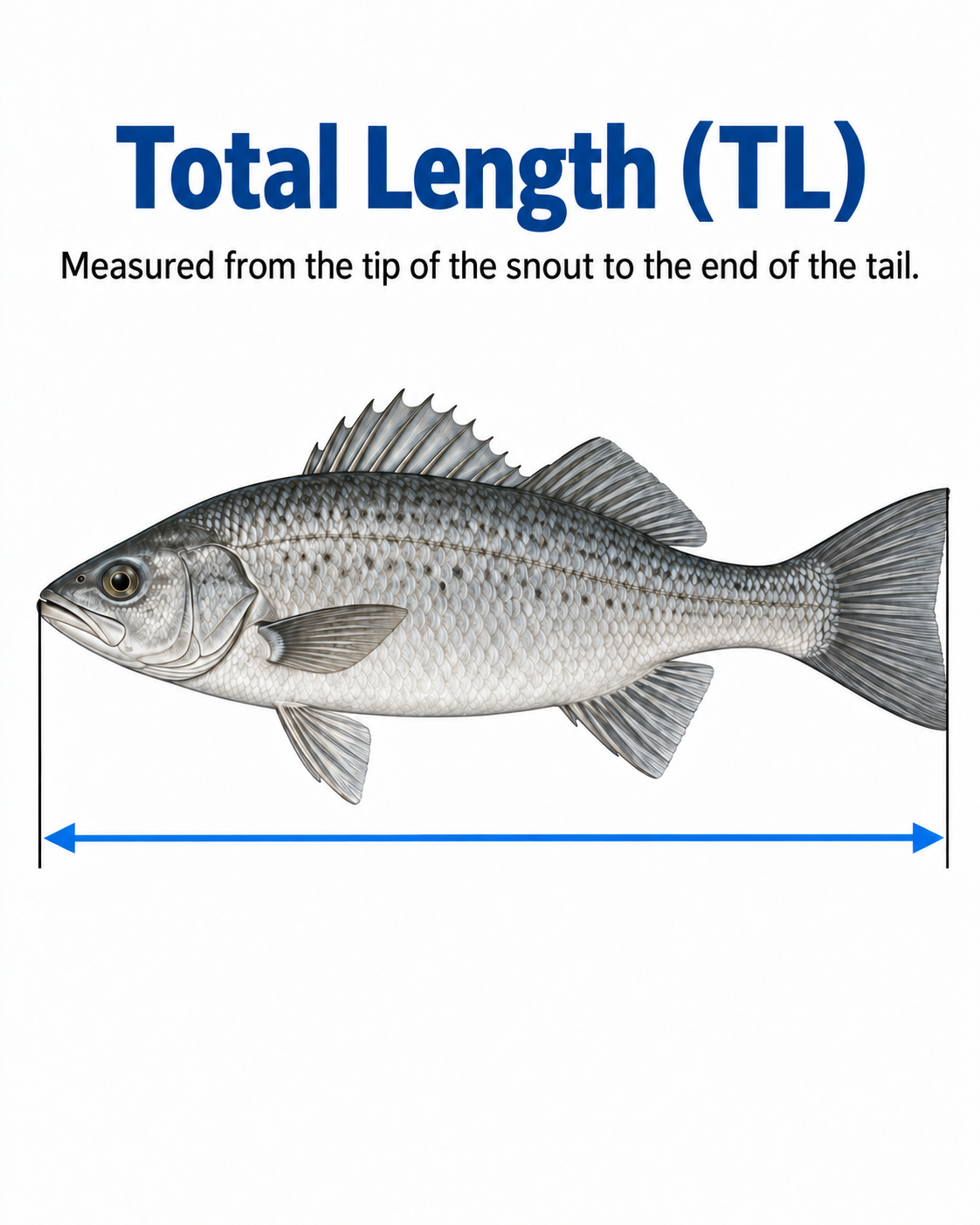
Total Length (TL) is FCA’s default measurement method when no other measurement convention has been prescribed for the species or jurisdiction.
Total Length is measured from:
the most forward point of the fish’s snout to the most distant point of the tail fin.
The fish should be positioned flat and straight along the measuring device.
Where permitted under the applicable measurement standard, the tail may be positioned sufficiently to determine the greatest legitimate overall length of the fish. The tail must not be stretched, pulled or manipulated beyond its natural range of movement.
The measurement is read at the farthest point of the caudal, or tail, fin.
Example
If the snout is positioned at zero and the farthest point of the tail reaches 12 ¾ inches, the recorded measurement is:
12.75 inches Total Length (TL)
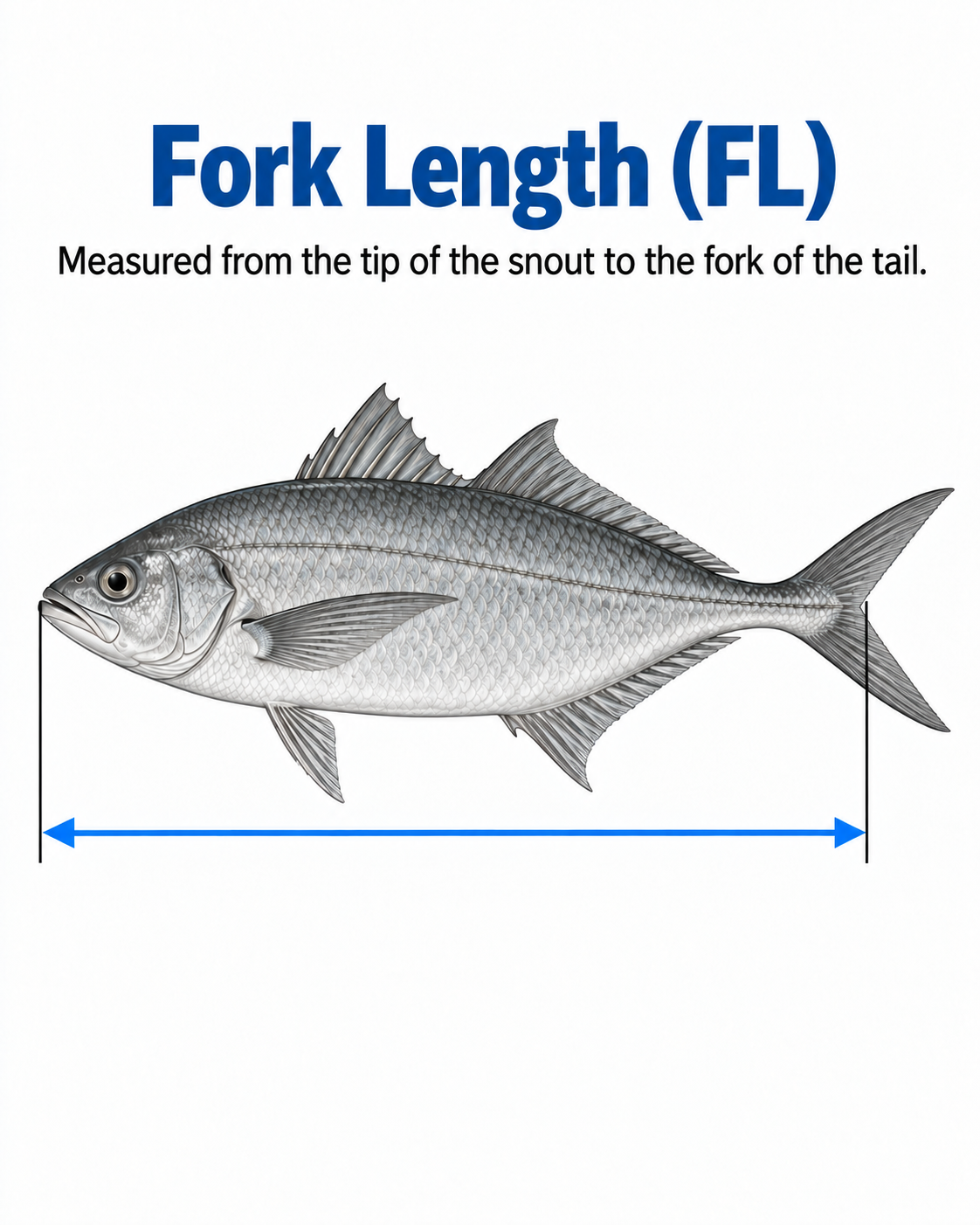
Fork Length (FL) is used for species with a distinctly forked tail and may be required by particular fisheries authorities.
Fork Length is measured from:
the most forward point of the fish’s snout to the centre of the fork in the tail.
The endpoint is the inward point where the upper and lower lobes of the caudal fin meet.
The outer tips of the tail are not included in a Fork Length measurement.
The fish should be positioned straight and flat along the measuring device, with the snout correctly aligned at the zero point.
Example
If the snout begins at zero and the centre of the tail fork reaches 56 1/2 inches, the recorded measurement is:
56.50 inches Fork Length (FL)
Fork Length is commonly used for certain marine, pelagic and other fork-tailed species because the outer tips of the tail may be flexible and can produce greater variation in Total Length measurements.
If FCA specifies Fork Length for a particular species and jurisdiction, Total Length should not be substituted unless FCA rules specifically permit the alternative measurement.
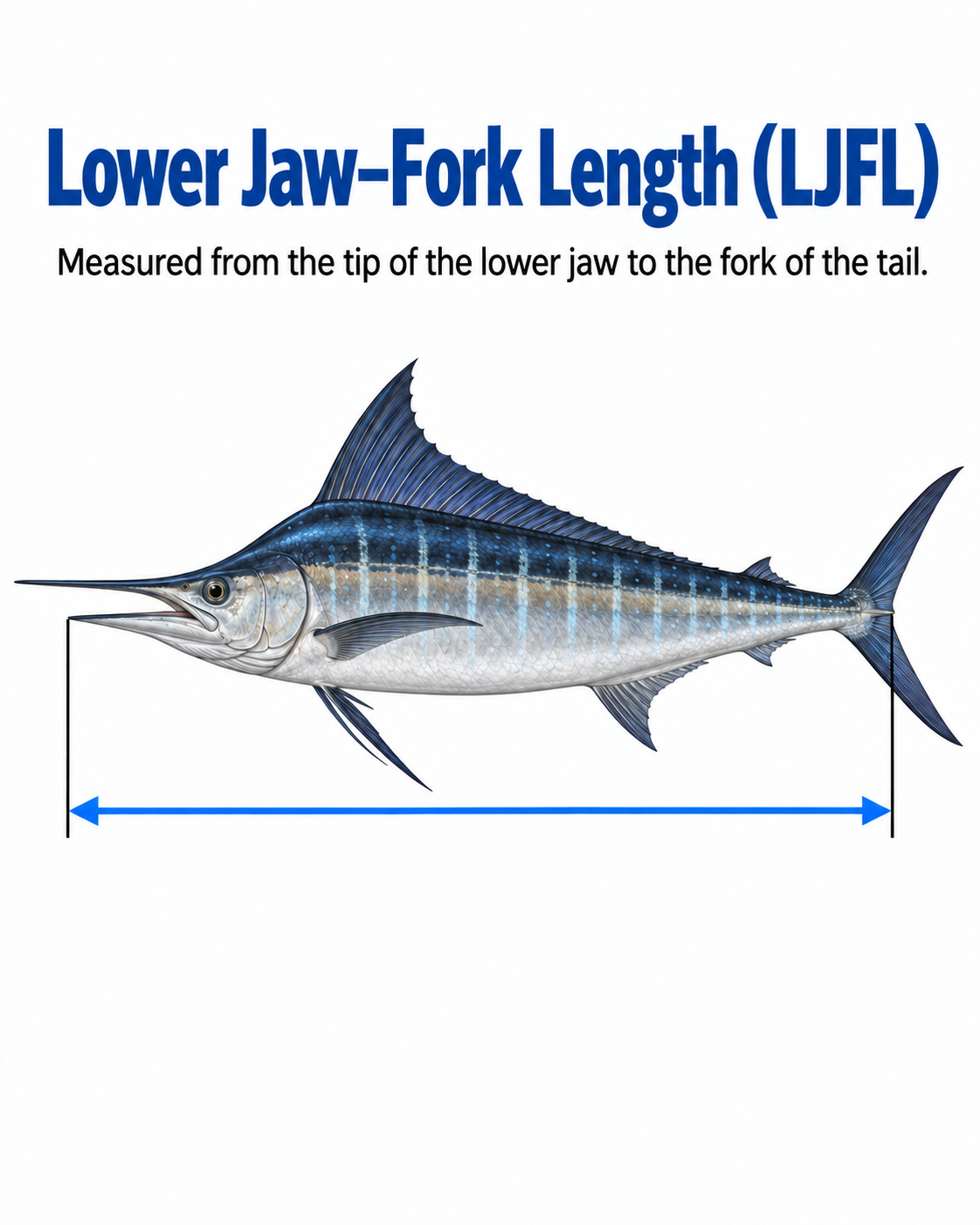
Lower Jaw–Fork Length (LJFL) is used when the applicable species or jurisdiction standard requires measurement from the lower jaw to the tail fork.
Lower Jaw–Fork Length is measured from:
the most forward point of the fish’s lower jaw to the centre of the fork in the tail fin.
The fish should be positioned flat and straight along the measuring device, with its mouth closed.
The measurement must follow a straight line rather than the curve of the body. The extended upper bill is excluded.
The measurement is read at the centre of the tail fork. Neither the jaw nor the tail may be stretched or manipulated to increase the measurement.
Example
If the tip of the lower jaw is positioned at zero and the centre of the tail fork reaches 60 ½ inches, the recorded measurement is:
60.50 inches Lower Jaw–Fork Length (LJFL)
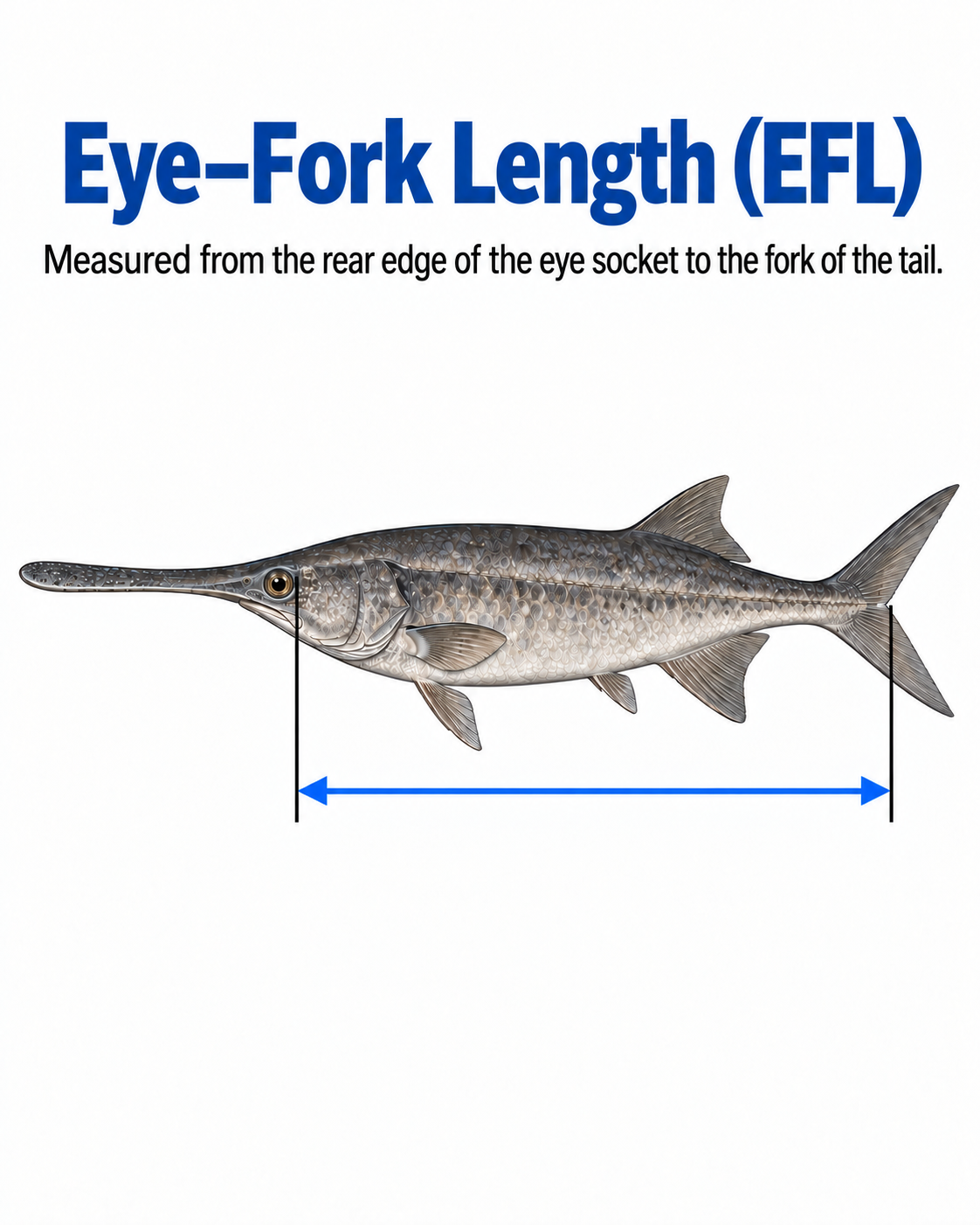
Eye–Fork Length (EFL) is used when the applicable species or jurisdiction standard requires measurement from a defined eye reference point to the tail fork.
Eye–Fork Length is measured from:
the rear edge of the eye socket to the centre of the fork in the tail fin, unless the applicable standard prescribes a different eye reference point.
The fish should be positioned flat and straight along the measuring device.
The measurement must follow a straight line rather than the curve of the body. The snout, jaws and extended bill are excluded.
The measurement is read at the centre of the tail fork. Confirm the required eye reference point before taking the measurement.
Example
If the required eye reference point is positioned at zero and the centre of the tail fork reaches 36 ¼ inches, the recorded measurement is:
36.25 inches Eye–Fork Length (EFL)
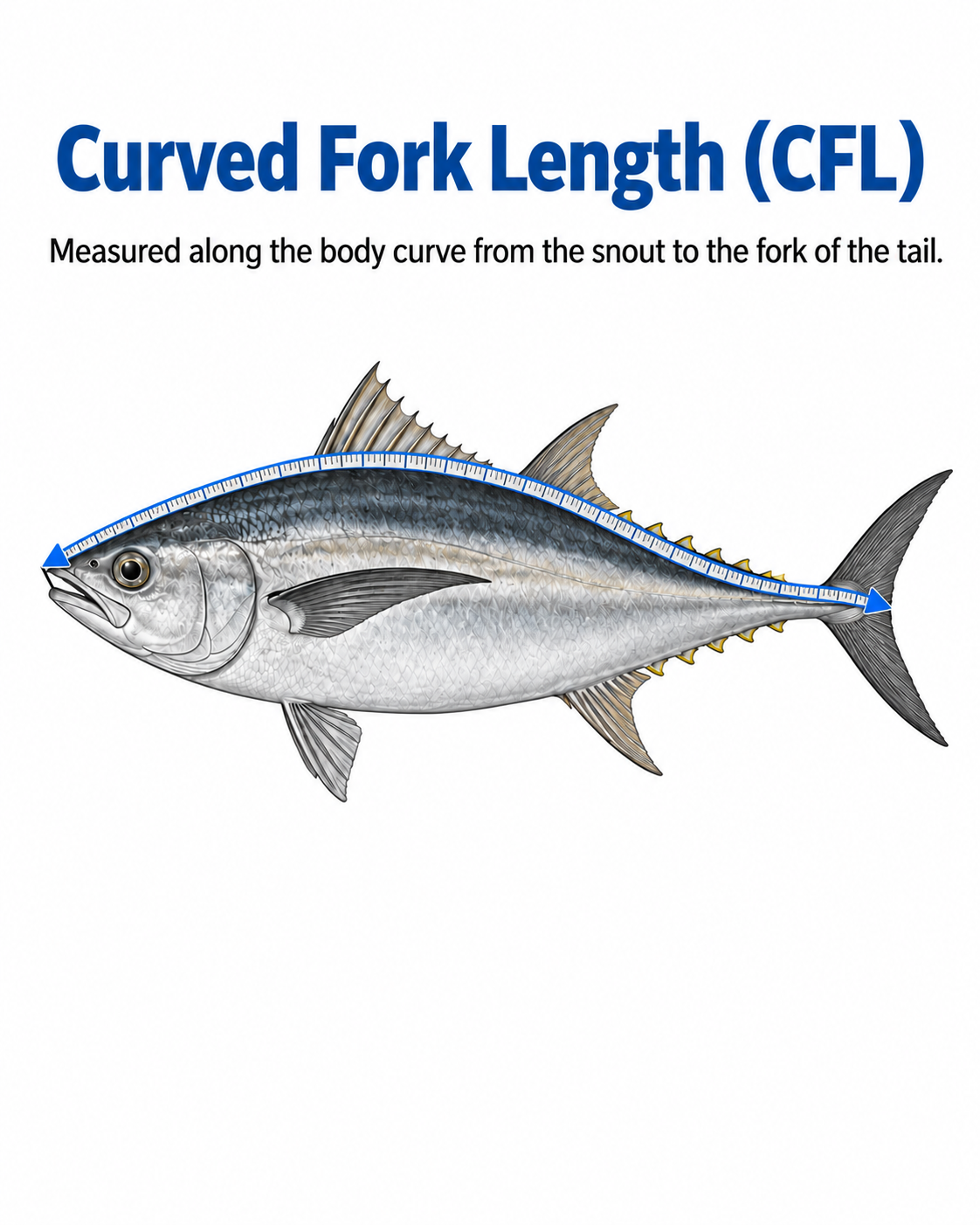
Curved Fork Length (CFL) is used when the applicable species or jurisdiction standard requires measurement along the curve of the fish’s body.
Curved Fork Length is measured from:
the tip of the upper jaw or snout, as prescribed by the applicable standard, along the body’s curve to the centre of the fork in the tail fin.
The fish should be positioned naturally, with a flexible measuring tape following the prescribed path along its body.
The tape must remain in contact with the body without being stretched, suspended above the fish or routed over raised fins. The fish must not be bent to increase the measurement.
The measurement is read where the tape reaches the centre of the tail fork.
Example
If the tape begins at zero at the required starting point and follows the body’s curve to a tail-fork reading of 47 ¼ inches, the recorded measurement is:
47.25 inches Curved Fork Length (CFL)
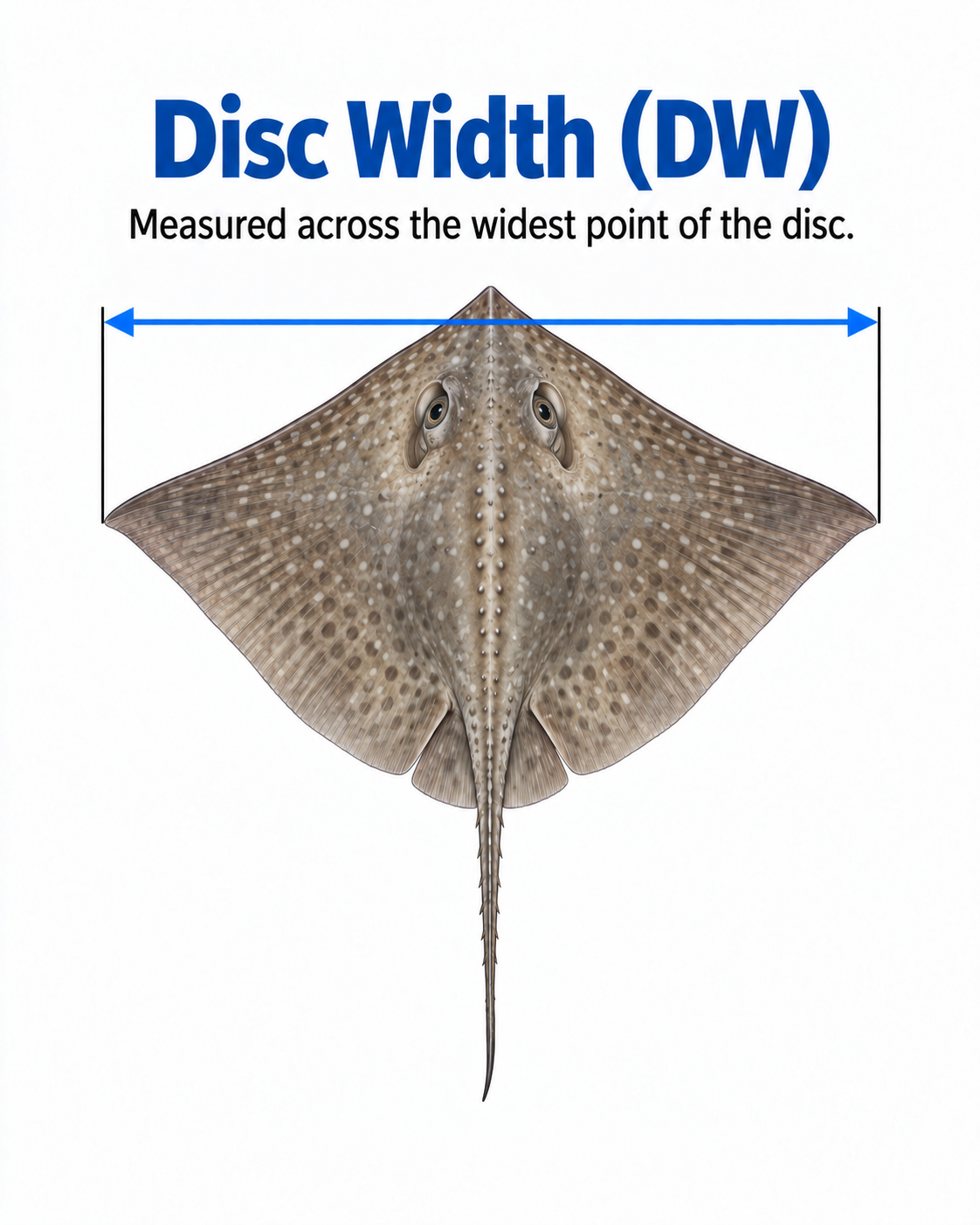
Disc Width (DW) is used when the applicable species or jurisdiction standard requires measurement across the body disc of a ray or skate.
Disc Width is measured from:
the outer edge of one wing to the outer edge of the opposite wing at the widest part of the disc.
The fish should be positioned flat, with both wings resting in their natural position.
The measurement must follow a straight line across the disc rather than the curve of the body. The wings must not be stretched, pulled or forced outward to increase the measurement.
The measurement is read at the opposite outer wing edge. The tail is excluded.
Example
If one outer wing edge is positioned at zero and the opposite edge reaches 24 ¾ inches at the widest part of the disc, the recorded measurement is:
24.75 inches Disc Width (DW)
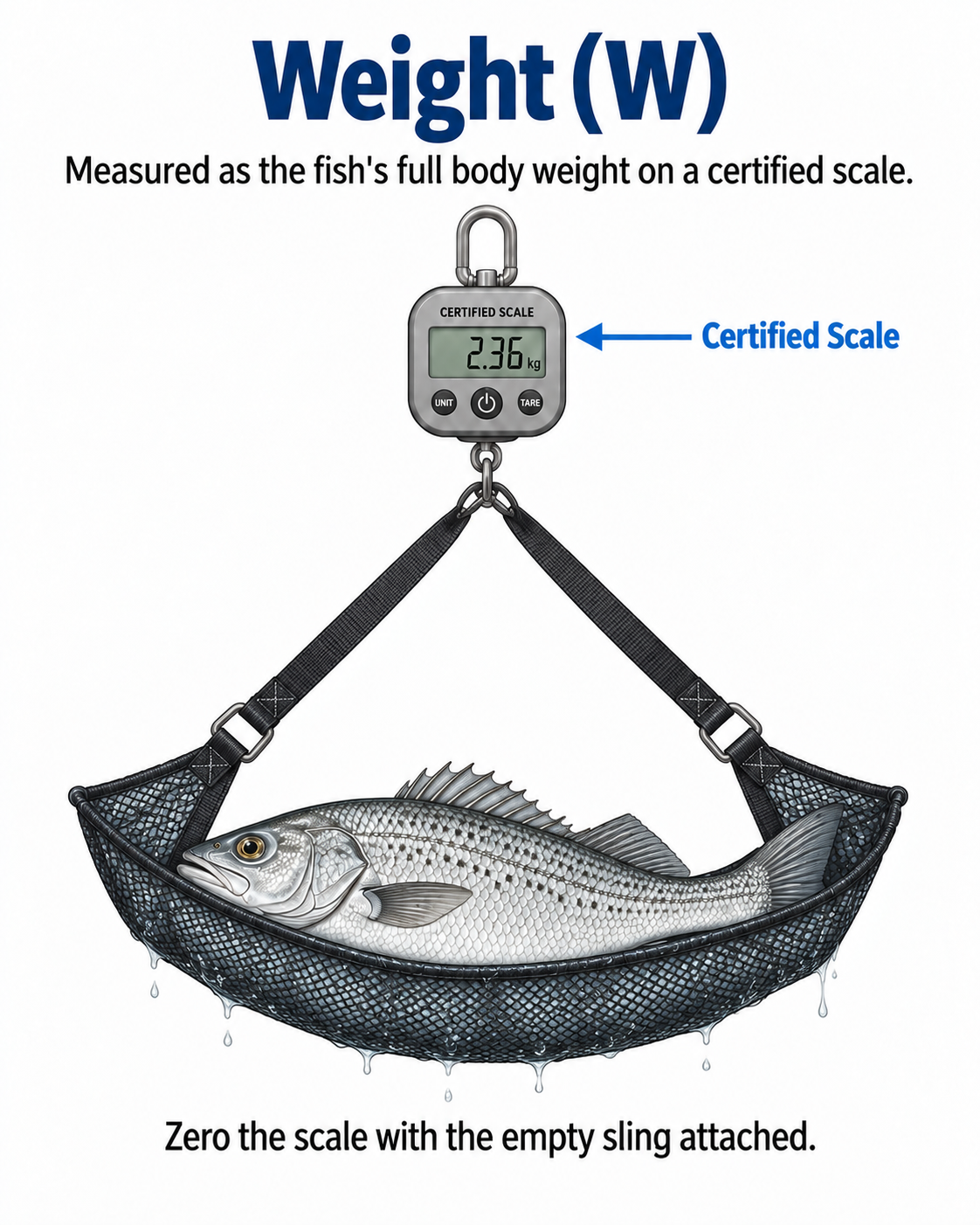
Weight (W) is used when the applicable species or certification standard requires the fish’s actual weight.
Weight is measured as:
the weight of the whole fish, excluding any sling, cradle, container or other weighing equipment.
The scale must meet the applicable accuracy and certification requirements.
Before weighing, zero the scale with the empty sling or container attached. Alternatively, determine its weight separately and subtract it from the combined reading.
The fish must be fully supported by the weighing equipment and clear of other surfaces. For fish intended for release, use a suitable supporting sling or cradle.
The weight is read once the scale display has settled. Record the displayed value and units without rounding upward.
Example
If the scale is zeroed with the empty sling attached and the fish produces a steady reading of 2.89 pounds, the recorded measurement is:
2.89 Pounds Weight (W)